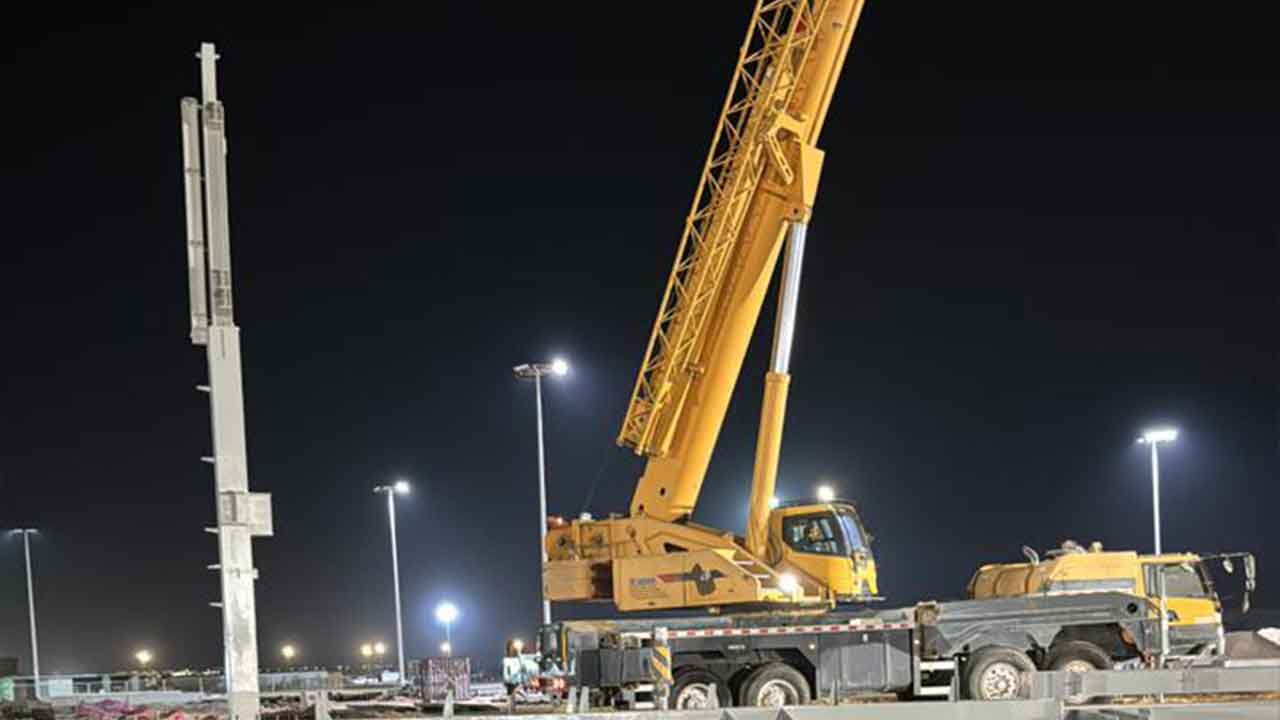
Cranes used in structural steel erection are not simply lifting machines; they are a decisive factor in the success of the entire project. They influence execution speed, safety level, accuracy of installation, and even the structural life cycle of the building itself. In steel erection, the crane’s role goes far beyond “lifting members from ground to roof.” Every degree of boom angle, every change in radius, every shift in load balance — can turn into vibration, instability, or a fall hazard that threatens lives.
The world of cranes can be summarized in three core pillars: load capacity — control systems — calibration and maintenance. A crane is not just a number printed on a plaque. It is a mechanical equation governed by: boom length, boom angle, working radius, lifting height, cable or sling type, sheave system, and ground stability.
In structural steel erection, multiple crane types are involved — mainly truck cranes, crawler cranes, and tower cranes. Each class has a specific working environment. Crawler cranes handle sandy or unstable soil better. Tower cranes are essential for vertical work and high-rise buildings. Truck cranes move faster between lifts or between close project zones.
Safe Working Load (SWL) is the most critical factor. Many accidents in steel erection occurred because someone misunderstood the crane load chart. Junior riggers often assume the number on the crane is “the maximum it can lift.” That is wrong. Loads are not fixed. The same crane might lift 50 tons at a 6-meter radius, but may only lift 12 tons at a 22-meter radius. Physics is harsh — increasing radius multiplies mechanical stress.
Therefore reading the load chart is a mandatory task — not optional — for every crane operator. In countries applying OSHA or ISO-based safety systems, steel erection cannot legally start without a Lifting Plan, including weight of the load, lifting point, sling angle, ground stability, boom radius, travel path, and exclusion zones for personnel.
Maintenance is a core part of crane safety. A crane may look powerful, but it can become a lethal threat within one second if the wire rope, brake lines, slewing ring, boom angle sensors, or telescopic boom chain are neglected. Historically, roughly 70% of crane collapses trace back to mechanical failure — because of incomplete maintenance, undetected corrosion, or exceeding the maximum service life of the wire rope.
Calibration is not luxury — it is a legal requirement. Cranes must carry valid certification before entering serious construction sites. The most recognized international standards include:
- LOLER
- ASME B30
- ISO 4301 / 4309
- OSHA 1926 Subpart CC
A certificate is not ink on paper — it is a compliance status verified by a third-party accredited inspector. In GCC countries, many authorities reject cranes with certificates older than 6 months unless the inspection body is ISO 17020 approved.
Calibration testing normally includes:
- Proof load test up to 110% of SWL (depending on jurisdiction)
- Load Moment Indicator (LMI) verification
- Brake system integrity check
- Wire rope wear and termination inspection
Another overlooked risk is sling angle. The same load becomes far more dangerous if lifted using only two slings at a wide angle. A 60° angle is drastically different from 30°. The wider the angle — the higher the horizontal tension.
Another key role is the Banksman / Signalman. The operator does not always see the load. Tight corners, sharp steel members, or workers operating at different elevations demand a supervised lift with strict communication protocols.
Wind is another critical factor. A long crane boom acts like an aircraft wing. High wind generates side lifting force, which can destabilize the machine. Many projects prohibit lifting above 9–12 m/s wind speeds — depending on crane type and boom length.
To conclude: crane work in steel erection is not “lifting engineering” — it is a full safety system. A crane can be the difference between a flawless project and a disaster. When proper load capacity calculation, accredited calibration, periodic maintenance, and competent supervision come together — the result is safe, precise lifting capable of executing the most complex structural tasks in modern construction.